1. Overview of UQPyL#
1.1. Introduction#
UQPyL is a Python package that provides a comprehensive set of methods for supporting various workflows, including design of experiments, sensitivity analysis, optimization, data mining, and their integration. To facilitate these workflows, UQPyL is organized into several modules: a. DoE (Design of Experiments); b. problems; c. sensibility; d. optimization; e. surrogates.
1.2. Workflow#
All methods and algorithms are implemented within a unified and consistent framework. As a result, UQPyL enables the construction of complete workflows such as:
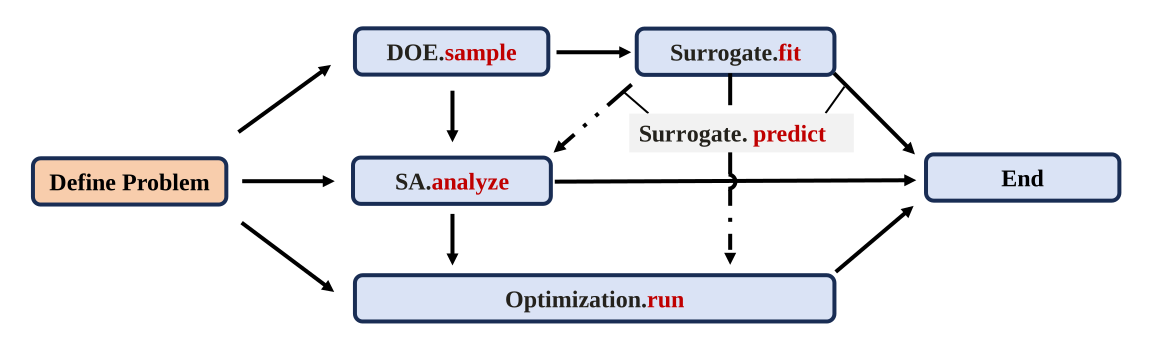
Full Workflow of UQPyL#
First, users should define solved problem. This problem acts as an interface to UQPyL.
Once the problem is defined, users can proceed through a variety of workflows:
Design of Experiments (DOE): All sampling methods contain
samplefunction. So usingDoE.sample()efficiently explore the input space and generate data for analysis or modeling.Surrogate Modelling: Based on the sampled data, surrogate models (e.g., polynomial regression, Gaussian processes …) can be trained by
Surrogate.fit(). These models provide fast approximations of the original, potentially expensive simulations.Sensitivity analysis:
SA.analyze()can quantify the impact of input variables on the outputs. It can either use the original model evaluations or the trained surrogate model viaSurrogate.predict()for efficiency.Optimization: With the original model or surrogate in place, optimization tasks can be carried out by
Optimization.run(), enabling design improvement or calibration.Integration: These modules are seamlessly connected. For practical problems, the entire workflow – “DoE -> Sensibility Analysis -> Optimization” can be carried out within UQPyL. Additionally, surrogate models can be employed to accelerate both sensitivity analysis and optimization processes.
Note
For detailed usage examples, please refer to the example collections page provided in this documentation.